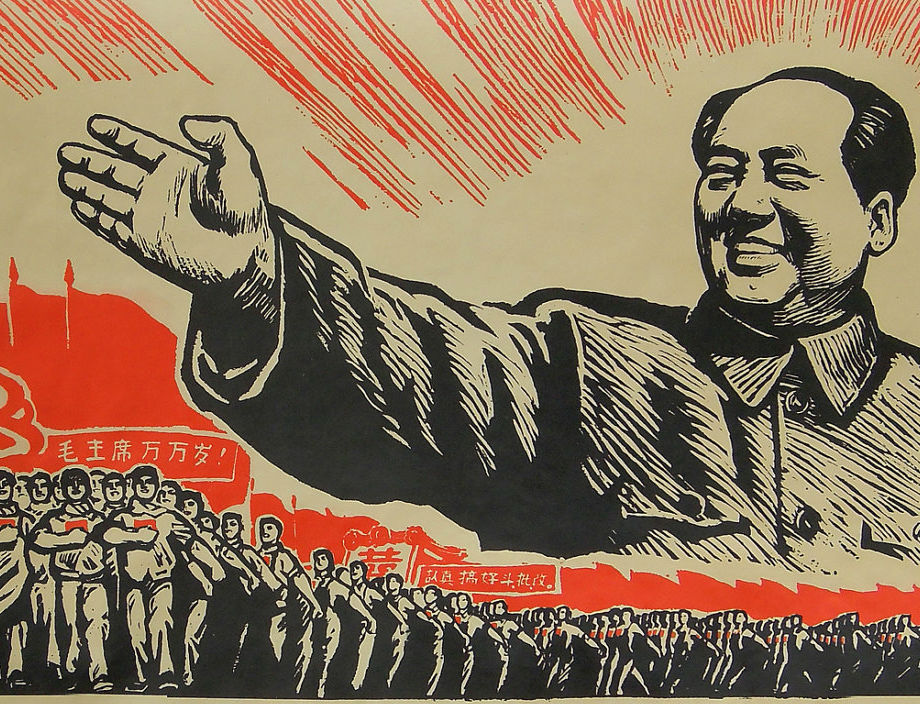
Mao Ze Dong
Mao Zedong was born on December 26, 1893, in Shaoshan village, Hunan Province, China. In 1911, Mao began middle school in Changsha. Revolutionary sentiment was strong in the city, where there was widespread animosity towards Emperor Puyi's absolute monarchy and many were advocating republicanism. Mao was influenced by Sun's newspaper, The People's Independence.
Mao moved to Beijing in 1917, where his mentor Yang Changji had taken a job at Peking University. Yang thought Mao exceptionally "intelligent and handsome", securing him a job as assistant to the university librarian Li Dazhao, who would become an early Chinese Communist. Li authored a series of New Youth articles on the October Revolution in Russia, during which the Communist Bolshevik Party under the leadership of Vladimir Lenin had seized power Mao was initially influenced by Peter Kropotkin's anarchism, which was the most prominent radical doctrine of the day. He joined Li's Study Group and "developed rapidly toward Marxism" during the winter of 1919.
The Communist Party of China was founded by Chen Duxiu and Li Dazhao in the French concession of Shanghai in 1921 as a study society and informal network. Mao set up a Changsha branch, also establishing a branch of the Socialist Youth Corps. Opening a bookstore under the control of his new Cultural Book Society, its purpose was to propagate revolutionary literature throughout Hunan. At the Third Congress of the Communist Party in Shanghai in June 1923, the delegates reaffirmed their commitment to working with the KMT. Supporting this position, Mao was elected to the Party Committee, taking up residence in Shanghai.
In 1927, Mao was appointed commander-in-chief of the Red Army and led four regiments against Changsha in the Autumn Harvest Uprising, in the hope of sparking peasant uprisings across Hunan.
In spring 1928, the Central Committee ordered Mao's troops to southern Hunan, hoping to spark peasant uprisings. Mao was sceptical but complied. They reached Hunan, where they were attacked by the KMT and fled after heavy losses. In November 1931, the Jiangxi Soviet (Chinese Soviet Republic) established with Mao as chairman.
On October 14, 1934, the Red Army broke through the KMT line on the Jiangxi Soviet's south-west corner at Xinfeng with 85,000 soldiers and 15,000 party cadres and embarked on the "Long March".
Mao's troops arrived at the Yan'an Soviet during October 1935 and settled in Pao An, until spring 1936. While there, they developed links with local communities, redistributed and farmed the land, offered medical treatment, and began literacy programs. Mao now commanded 15,000 soldiers.
In July 1937, after the second Sino-Japanese War. Under the agreement of Mao and Chiang, the Red Army was reorganized and placed under the command of the National Revolutionary Army. The CCP agreed to accept the leadership of Chiang Kai-shek and began to receive some financial support.
After the end of World War II, the U.S. continued their military assistance to Chiang Kai-shek and his KMT government forces against the People's Liberation Army. In 1948, under direct orders from Mao, the People's Liberation Army starved out the Kuomintang forces occupying the city of Changchun. In the early morning of December 10, 1949, PLA troops laid siege to Chongqing and Chengdu on mainland China, and Chiang Kai-shek fled from the mainland to Taiwan.
During the land reform campaigns launched by Mao, large numbers of landlords and rich peasants were beaten to death at mass meetings organised by the Communist Party as the land was taken from them and given to poorer peasants, which significantly reduced economic inequality.
In 1953, Mao launched the First Five-Year Plan (Great Leap Forward) which aimed to end Chinese dependence upon agriculture in order to become a world power. With the Soviet Union's assistance, new industrial plants were built and agricultural production eventually fell to a point where the industry was beginning to produce enough capital that China no longer needed the USSR's support. However, failed with a large number of starved death. Mao stepped down as State Chairman of the PRC on April 27, 1959, but remained CCP Chairman.
After Great Leap Forward, Mao believed that a revolution of culture would unseat and unsettle the "ruling class" and keep China in a state of "perpetual revolution" that, theoretically, would serve the interests of the majority, rather than a tiny and privileged elite, however, many civilians died during the culture revolution. When Mao was informed of such losses, particularly that people had been driven to suicide, he is alleged to have commented: "People who try to commit suicide—don't attempt to save them" China is such a populous nation, it is not as if we cannot do without a few people."
In 1969, Mao declared the Cultural Revolution to be over, although various historians in and outside of China mark the end of the Cultural Revolution—as a whole or in part—in 1976, following Mao's death and the arrest of the Gang of Four.
During the Culture Revolution, Mao chose Lin Biao to become his successor. Lin was later officially named as Mao's successor. By 1971, however, a divide between the two men had become apparent. Official history in China states that Lin was planning a military coup or an assassination attempt on Mao. Lin Biao died on September 13, 1971.
At 00:10, on September 9, 1976, Mao Zedong died, possibly caused by Parkinson's disease. On September 17, Chairman Mao's body was taken in a minibus from the Great Hall of the people to Maojiawan to the 305 Hospital that Liu Zhisui directed, and Mao's internal organs were preserved in formaldehyde.