International Baccalaureate Philosophy
Core Theme Collection
Personhood
Personhood is a concept of being a person, a concept of human identity? Its definition has multiple criteria according to different philosophers. Most of the criteria are to address the problem of human identity and to address the question, "Who am I?".
René Descartes
Descartes’ conception of a person as essentially a thing that thinks means, according to him, that the principle of mereological identity is satisfied very easily by persons. A mind has all the same parts from one time to another for the simple reason that a mind’s only part is itself.

No mind consists of several things somehow joined together into a complex unity. By contrast, every physical thing does consist of several physical things joined together. Every physical particular is a complex particular, according to Descartes. This means that every physical particular is a sort of assemblage of separable parts or it is divisible into parts. Minds are continuant substances which are not divisible into parts. Descartes suggests that human experiences could be illusional, by contrasts, human rationality exists purely which could represent the true identity of a human, thus identity should be defined by the rationality of human being.
David Hume
Hume claims that we have no experience of a simple and individual impression the self— which is the totality of a person’s conscious life. In his works, he wrote “when I enter most intimately into what I call myself, I always stumble on some particular perception or other, of heat or cold, light or shade, love or hatred, pain or pleasure. I never can catch myself at any time without a perception, and never can observe anything but the perception”

For Hume, humans are bundles of different perceptions (Experiences) I nevertheless have some idea of personal identity. Because of the associative principles, the resemblance or causal connection within the chain of human perceptions gives rise to an idea of "myself", and memory extends this idea past their immediate perceptions. A common abuse of the notion of personal identity occurs when the idea of a soul or unchanging substance is added to give humans a stronger or more unified concept of the self.
John Locke
John Locke argues to consider the identity of a human being, humans must know that they are themselves throughout times, which means that they can prove their identity. He suggests that the self is "a thinking intelligent being, that has reason and reflection, it can consider itself as itself, the same thinking thing, in different places and situations, it continues to define personal identity simply as the sameness of a rational being."
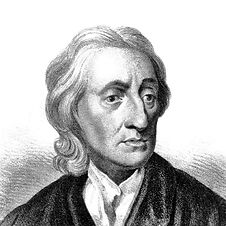
For Locke, the identity is continuous, only if humans do have the ability to reason at the beginning and they keep our identity at the beginning. Locke suggests that one personally identifies extends and persists only so far as one's consciousness. The consciousness Locke refers to can be equated with memory. Memory, therefore, is a necessary condition of personal identity.